How to Get Bolivia Residency: Full Process (2026)
Bolivia is one of the most overlooked countries in South America for residency, and that is exactly what makes it interesting. The cost of living is among the lowest in Latin America, the tax system does not touch genuinely foreign-source income, and the residency process is faster, simpler, and cheaper than nearly any other country in the region. I went through this exact process myself in 2025 at the DIGEMIG office in Santa Cruz, and have since walked dozens of clients through the same path with the same lawyer team.
I still maintain my residency and plan to apply for permanent as soon as I am eligible. This guide covers everything: how the process works, what it costs, how long it takes, and what to expect on the ground.
Bolivia Is Not Like Other Countries
If you have been researching residency in South America, you have probably noticed that most countries offer a menu of visa options designed to attract foreign income. Paraguay has its SUACE investment pathway. Argentina has the rentista visa for people with passive income. Other countries, including Colombia and Brazil, have dedicated digital nomad categories. Bolivia does not have any of those specific categories. There is no dedicated pensioners visa, no rentista visa, and no digital nomad visa.
But there is a clear path that many foreigners can follow. Bolivia’s residency system functions like a basic open residency program, it is just not written or marketed as one. The visa categories are practical and traditional (work, student, volunteer, family, business), and through the work residency in particular, most foreigners with independent work and the means to support themselves can qualify without much difficulty.
This is actually part of what makes Bolivia appealing. The country is not flooded with expat-targeted immigration services charging premium prices. The process is straightforward, the costs are low, and the government is not constantly changing the rules to attract or restrict digital nomad inflows. It is stable and predictable.
Most foreigners who get Bolivia residency do so through the work residency category. If you are coming from the US, Europe, or Australia with remote income or savings, that is almost certainly your route, and it does not require a Bolivian employer. I explain exactly how it works in the next section, because it is the part people get wrong most often.
You Need a Reason to Stay: Residency Categories
Bolivia does not hand out residency without a valid basis. You need a documented reason for being in the country, and that reason determines which type of temporary residency you apply for.
Work Residency: The Route for Almost Everyone
This is the one that applies to almost everyone reading this. If you are coming from the US, Europe, or Australia with remote income, freelance clients, or savings, this is your route. I would put it at 95% of the people who come to me about Bolivia.
The name is misleading. Work residency does not mean you need a job in Bolivia, and it does not mean a company has to sponsor you. There are two ways to file under this category, and the difference between them matters.
Route 1: self-solvency as an independent worker. This is the one I recommend. You show that you have the economic means to support yourself while you are in Bolivia, and you declare that you are working independently rather than for a Bolivian company. Nobody sponsors you and nobody employs you. You are an independent worker with the funds to live here.
This gives you one year of temporary residency, and you renew it each year. Those years count toward permanent residency after three continuous years and eligibility to apply for naturalization after more than three years.
Route 2: a real work contract with a Bolivian employer. Bolivia also grants work residency for one, two, or three years when there is an actual employment contract with a local company behind it. If you genuinely have a job offer here, this is legitimate and it is the correct category for you.
Here is where it gets tricky. A number of firms in Santa Cruz will offer you a two or three year residency up front by producing a work contract that is not real. Nobody is going to employ you and nobody is going to pay you. It is a piece of paper that a migration officer looks at and signs off on, and because of how Bolivia’s migration system works, it is not checked and not enforced.
I do not recommend it. You would be lying about your reason for being in the country to save yourself a renewal appointment. That is a bad trade, and it is unnecessary, because there is a clean way to get the same result.
The clean version of the two year option. You enter on the self-solvency route as an independent worker for your first year. After that year, you register your own unipersonal business and obtain its NIT, the tax identification number. The business has very low setup and maintenance costs. You use the registered business and evidence of its activity to file for a two year residency covering years two and three. A genuine employer can also support that two year renewal.
That is a real business that exists and that you own. You entered Bolivia as an independent worker, then established your own business. Every part of it is true.
The practical benefit is that you do one renewal instead of two. The business is also useful for other things once you have it, which is worth thinking about separately.
Once you reach permanent residency, you no longer renew the temporary permit. Your cedula still needs renewal, and permanent residents can be away for up to two continuous years without express authorization.
If you are not sure which of these fits your situation, contact me here and I will tell you straight.
The Other Residency Categories
These apply to a smaller number of people, but they are worth knowing about.
Student visa. If you are open to taking Spanish classes, this is another straightforward option. Even attending classes a couple of days per week (sometimes as little as one day per week) can qualify. This is a good choice if you want to improve your Spanish while establishing residency at the same time, but student residence does not count toward permanent residence.
Civil union or family. If you have a Bolivian partner or family ties in the country, this provides a direct path to residency.
Volunteer visa. Less common, but available if you are doing volunteer work with a recognized organization.
Business or professional visa. This category covers entrepreneurs and professionals but tends to involve more paperwork and a longer processing timeline. Most people do not need this route unless they are establishing a formal business in Bolivia.
For almost everyone relocating with remote income or savings, the self-solvency work residency is the path. It is the simplest, the fastest, and the one with the least friction. The rest of this guide assumes that is what you are doing.
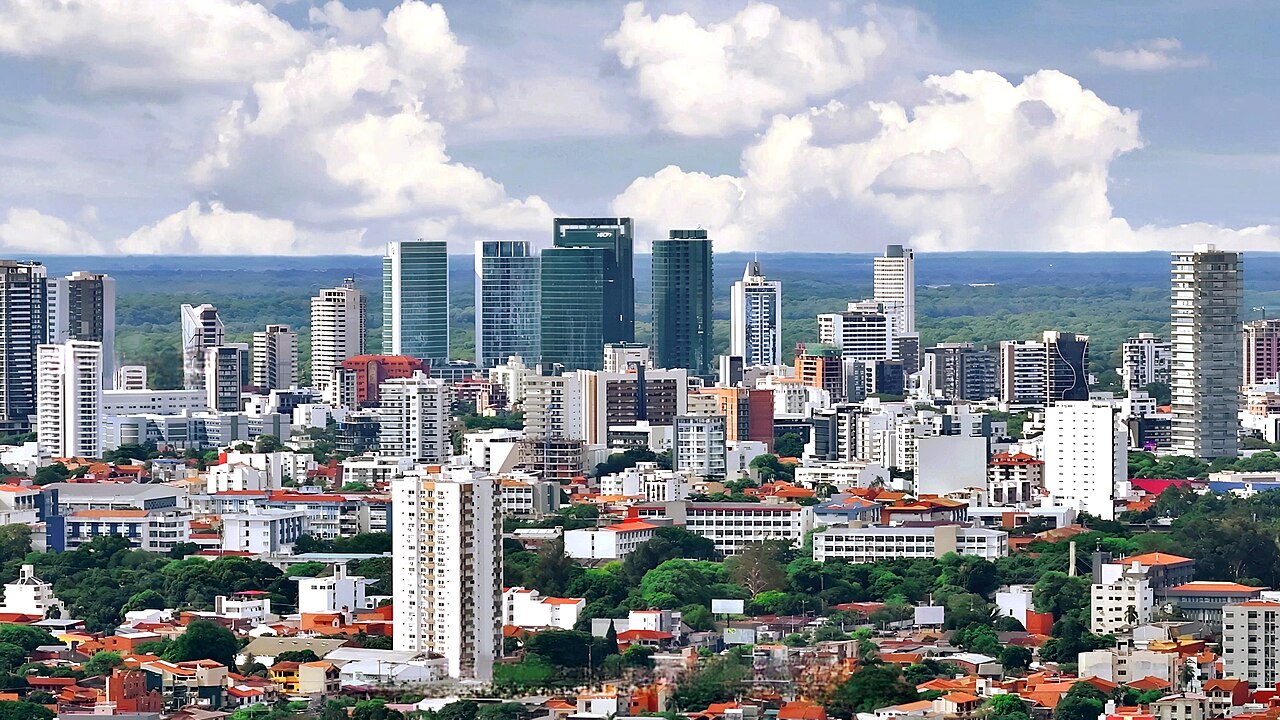
Santa Cruz de la Sierra.
The Path to Permanent Residency Runs Three Years
For the standard qualifying work route, you can apply for permanent residency after three continuous years of temporary residency, not two. That is the number to plan around.
You become eligible to apply for naturalization after more than three years of uninterrupted legal residence. So when you get there you have a choice: convert to permanent residency, or apply for Bolivian citizenship. Most people take permanent residency and decide about the passport later, but it is worth knowing that both doors open around the same time.
How you fill those three years is the decision I covered above. Either three one year self-solvency renewals, or one year of self-solvency followed by a two year residency through your own business. Both arrive at the same place.
Do Not Try to Do This Alone
Before I walk through the process step by step, I want to be upfront about something: we do not recommend people try to do Bolivia residency alone, especially without Spanish.
The residency process itself is not complicated on paper. But the reality on the ground involves scheduling an appointment at Interpol, getting a specific medical exam from an approved doctor, managing the migration office and its lines, filling out the application form correctly, and presenting your case to the officer who reviews and approves your file. All of that scheduling, waiting, understanding what is needed at each step, and communicating with government officials is difficult without a lawyer and a team coordinating for you.
Local residency teams (like ours) know how to get the first appointment at the perfect time so that everything moves quickly. We know which doctor to go to, when Interpol is least busy, and how to prepare your documents so nothing gets kicked back. With a lawyer handling the process, residency literally takes about a week on average. You can do it even faster if you have no other daily obligations while you are here. Alone, the process will take you at least one month, and more likely two.
And then there is the migration office itself. The people responsible for approving your residency will ask you questions, and they often rush through them. You want someone with you to handle this part. I fumbled this entirely and lost my place in line when I tried to do the migration office on my own. I came back with help and got it done instantly.
Here is an example of what I mean. For migration office appointments, the best time to arrive is right when the office opens. You get in quicker, you are first in line. If you show up mid-day, you will still get things done, but you will be there for 4 to 6 hours.
So what do people do? They start lining up outside before the 8am open time so they can be first in line. That line gets very long. People have learned to show up and start lining up at 2 or 3am so they can be legitimately first.
The way around that: smart lawyers pay someone to show up at 2:00am to hold the number one spot in line, right outside the migration office front door. Later, at 6:00am, the lawyer’s assistant shows up and takes the spot from the placeholder. Then at 7:50am, you show up, walk in at 8:00am, and you are first in line.
You should not try to run this play solo. This is included in what a good residency team handles for you.
We get people residency in Bolivia without confusion or delays, because we know the system inside and out. Book a call with us here.
And then there is the application form itself. It is in Spanish, the formatting is specific, and small mistakes mean you have to come back another day. Not something you want to figure out on your own.
Speaking Spanish helps, but it is not necessary to get through the process if you work with a lawyer and team who handle the coordination for you. If you do speak Spanish, great, it will make daily life easier. But do not let a lack of Spanish stop you from pursuing residency. Just make sure you have proper support.
You Do Not Need to Go Home for Documents
This is one of Bolivia’s biggest advantages, and it deserves its own section because it saves you an enormous amount of time and money compared to other countries.
Our standard first-year independent-work route does not normally require apostilled documents. You do not need an apostilled birth certificate or criminal background check from your home country. You bring your passport and the bank statements described below. Family applications and later citizenship applications have different document requirements.
If you have looked into residency in Paraguay or Argentina, you know how painful the document requirements are. For Paraguay, you need an apostilled birth certificate and an apostilled FBI background check (or equivalent from your home country). That means requesting the documents from the issuing agencies and arranging the correct apostille: a US state authority for a state birth certificate, and the US Department of State for an FBI report. Mailing or an authorized representative may avoid a flight home. The whole process typically takes 4 to 8 weeks and costs several hundred dollars just in fees, not counting flights.
Argentina is the same story. Apostilled birth certificate, apostilled criminal background check, and the Argentine consulate in your home country often needs to verify them as well. People regularly spend months going back and forth getting documents ready before they can even start the residency application.
This route skips all of that. Your criminal background check is done locally through Interpol in Santa Cruz or La Paz. Your medical exam is done locally at a doctor’s office. Everything you need is gathered on the ground in Bolivia over a few days. You show up with your passport and bank statements, and the local checks happen here.
This alone makes Bolivia the fastest path to residency in the region. You can start the filing process on a Tuesday and have your residency approved by the following week. Try that in Paraguay or Argentina.
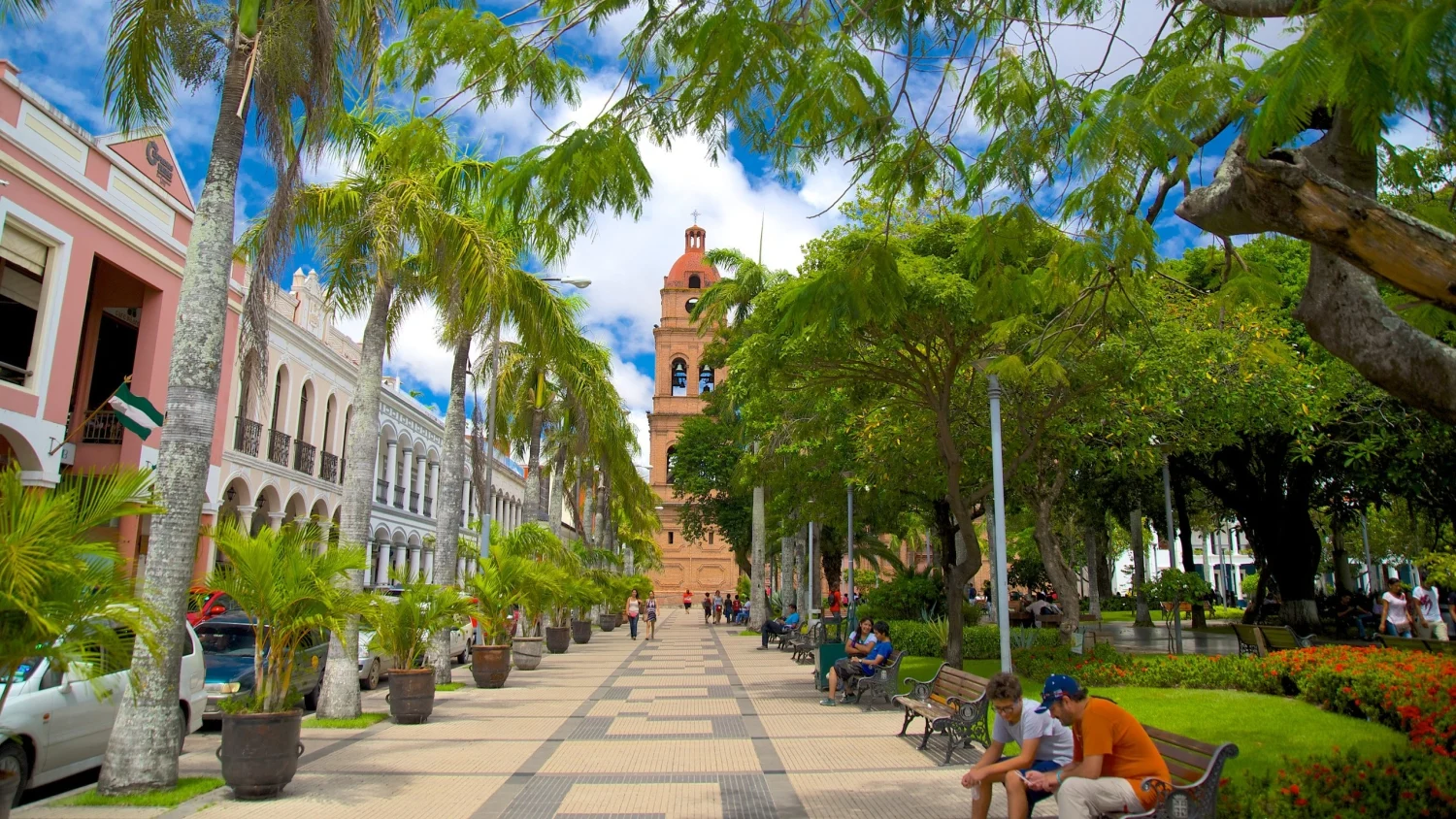 Plaza 24 de Septiembre, Santa Cruz.
The Residency Process: Step by Step
You can get your residency done in several cities across Bolivia, but the best city to do it is Santa Cruz de la Sierra. It is the largest city in the country, the economic capital, and the migration office here tends to move faster than in other cities. You fly into Viru Viru International Airport (VVI).
These steps assume you are filing the self-solvency work residency as an independent worker, which is the right route for almost everyone reading this. If you are going through a family, student, or genuine employment category instead, most of this still applies but your document list will differ. If you are unsure where you stand, contact me here.
For this independent-work route, you can file after 15 days in Bolivia. Here is how the process works:
Meet with your lawyer. Your lawyer will review your situation and recommend the best residency category for you. Bring your passport and be ready to discuss your plans. You will settle the lawyer’s fee at this stage.
Gather your documents. This all happens locally in Bolivia, usually over a few days:
- Medical exam: You visit a doctor for a basic health checkup, including a blood test and STD screening. This is a standard requirement.
- Interpol background check: You go to the local Interpol office where they run an international criminal background check. This is done in Santa Cruz or La Paz, not in your home country.
- Financial solvency: For this independent-work route, our team uses three months of bank statements with an average running balance of roughly $700. It is a savings test, not a monthly income test, and the statements can come from the bank account you already have abroad.
- Proof of profession: Depending on your residency type, your lawyer may ask you to show some evidence of your profession. A resume, LinkedIn profile, or a couple of references is usually enough.
- Domicile information: Documentation of where you are living or plan to live in Bolivia. A rental agreement or utility bill works.
- Passport photos and photocopies: Standard ID photos and copies of your passport pages.
Submit at the migration office. Once your documents are ready, you (or your lawyer’s team) will go to the DIGEMIG migration office in downtown Santa Cruz or La Paz. A common practice is to have someone hold your spot in line early in the morning so you can arrive at a reasonable hour and go straight in. Your lawyer will arrange this. You receive a number at the front desk, go upstairs, wait for your number, and present your documents. If everything is in order, your temporary residency is approved on the spot and stamped into your passport.
Receive your ID card. Through our team, you can pick up your card at SEGIP within two weeks of residency approval. Your lawyer will arrange the appointment. There, you take another photo, do fingerprints, and receive your Bolivian ID card (cedula de identidad). Your ID number will start with an “E” for extranjero (foreigner). This number is what you use to open bank accounts, get a driver’s license, sign contracts, and do everything else as a legal resident.
Allow about a week for the active residency process. With a few weeks of advance notice, our team can complete that work in one or two days, with approval on the day we submit.
Interested in Bolivia residency? We get people their residency done on an expedited basis, directly with lawyers here in Santa Cruz. Reach out to us here.
What Does It Cost?
Our one-year residency package costs $1,800 end to end. That covers lawyer and government fees, medical, Interpol, local certificates, cedula issuance, document guidance and translations, and coordination. You show up with your passport and the local paperwork is taken care of. The full Bolivia residency cost breakdown covers the individual steps.
This is significantly less than Paraguay (where done-for-you residency typically runs $3,000+) or Argentina. And because our standard first-year route normally avoids apostilled home-country documents, you also save the weeks of processing time and document costs that those countries demand.
Physical Presence Requirements: 90 Days Outside Bolivia
This is the one area where Bolivia is more restrictive than its neighbors, and it is important to understand before committing.
As a temporary resident, you cannot spend more than 90 total days outside Bolivia per year without express authorization from Migración. Separate trips count toward that total. If you exceed the limit without authorization, your temporary residency can be revoked and you may have to start the residency process over again.
However, it is possible to obtain express authorization from Migración for up to 180 days of allowed absence per year. It takes some extra steps, and it is not something you file the day after your residency is approved. You need to be settled into your residency first, and you need a real business justification behind the request with the documentation to support it. Done properly it is very achievable, and my team handles these regularly. If flexibility to travel matters to you, plan for it as a second step rather than part of the initial process.
Once you upgrade to permanent residency (after three continuous years of temporary residency), the rules relax significantly. Permanent residents can leave Bolivia for up to two consecutive years without express authorization. Your cedula still needs renewal.
Is the 90 day rule a dealbreaker? That depends on your lifestyle. If you want a residency purely on paper while living somewhere else most of the year, Bolivia is not the right fit. But if you actually plan to live here, it is very manageable. In my first year, I spent about 50 days outside the country for work trips and visits back to the US, and staying under the limit was never an issue.
Bolivia’s Tax System: No Tax on Foreign Income
Bolivia operates a territorial tax system, meaning the government only taxes income that originates within Bolivian borders. If your income is genuinely earned outside Bolivia (foreign investment returns, pensions, or rental income from properties in other countries), Bolivia does not tax any of it.
This applies to foreign residents as well as citizens. The source of the income matters, not the country of the bank account receiving it.
For income earned within Bolivia, the RC-IVA rate is 13% where that tax applies. Work physically performed in Bolivia can be Bolivian-source even if your employer or clients pay you from abroad.
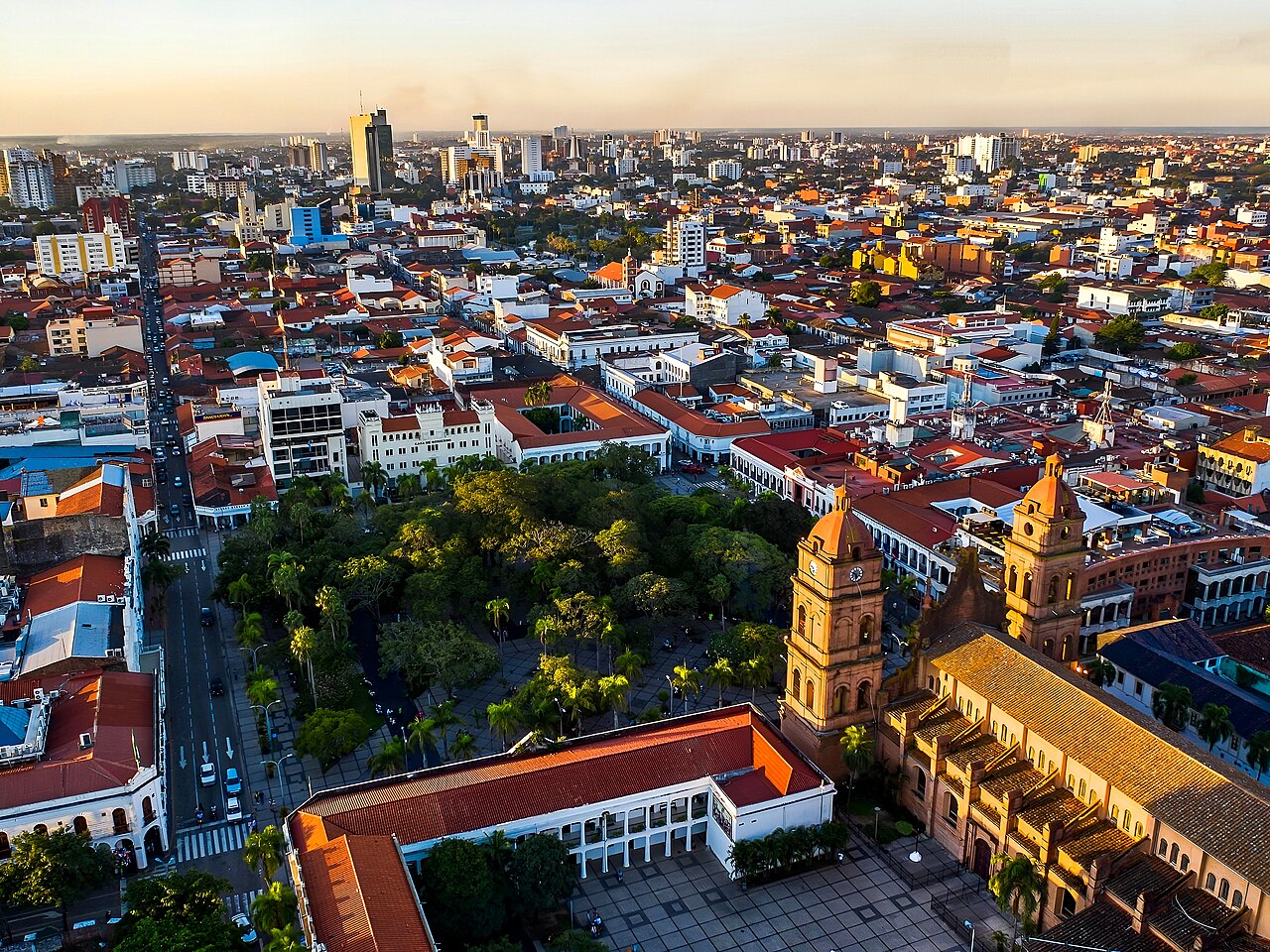 Downtown Santa Cruz at sunset.
What Daily Life Actually Looks Like
Most people who come to Bolivia for residency end up basing themselves in Santa Cruz de la Sierra, and for good reason. It is the most livable city in the country for someone arriving from abroad.
Santa Cruz is not what most people picture when they think of Bolivia. Forget the images of high altitude deserts and llamas. The city sits at about 400 meters elevation in the tropical lowlands. The weather is warm to hot year round, the city is lush with vegetation, and the general quality of life is surprisingly high for what you pay.
A comfortable lifestyle runs $1,000 to $1,500 per month for a single person. Rent for a nice one bedroom apartment in the Equipetrol neighborhood (the safest, most convenient area for foreigners) is roughly $300 to $500 per month. Utilities, groceries, transportation, and eating out are all extremely affordable.
Healthcare is affordable and accessible. A doctor visit runs $10 to $30, and private health insurance costs $50 to $200 per month. Safety is reasonable. Like any Latin American city, you should be aware of your surroundings, but Santa Cruz is comfortable and safe by regional standards.
How Bolivia Compares to Paraguay and Argentina
If you are considering South America for residency, you are probably looking at a few countries. Here is how Bolivia stacks up against the two most common alternatives.
Vs. Paraguay: Bolivia is cheaper and far faster, with a locally assembled standard first-year file and approval in about a week through our team. Paraguay costs more and takes months, but it barely asks you to be there, which makes it the better choice for a residency you hold rather than live in. I broke the two down side by side in Bolivia vs Paraguay residency.
Vs. Argentina: Argentina also requires apostilled documents and the process tends to be slower and more bureaucratic. Argentina’s economy is volatile, and while Buenos Aires offers a cosmopolitan lifestyle, the cost of living has risen sharply in recent years. Bolivia offers more stability in day to day costs and a much simpler immigration process.
Pick based on where you are actually going to be. Bolivia rewards people who show up. Paraguay rewards people who need a legal foothold while living elsewhere.
Who Should Consider Bolivia?
Bolivia is ideal for a specific type of person: someone with remote income or savings who wants to live affordably in a warm, tropical city with no Bolivian tax on genuinely foreign-source earnings, and who does not mind spending most of the year in the country.
It is a particularly strong fit if you are a remote worker or freelancer earning in USD. Your purchasing power here is enormous. A salary that feels modest in the US goes a very long way in Santa Cruz.
Retirees are another natural fit. If you are living on a pension or fixed income and want to stretch it as far as possible in a warm, affordable place with no Bolivian tax on a foreign pension, Bolivia delivers on all of that. The cost of living is lower than almost anywhere else in Latin America, the healthcare is cheap and accessible, and the pace of life is relaxed. You also get a level of privacy and simplicity that countries actively marketing to retirees (like Costa Rica, Panama, or Mexico) no longer offer. A pension proves solvency; the application still needs a work, family, or other qualifying basis.
Bolivia also works for anyone who values simplicity in the immigration process and does not want to deal with apostilled home-country documents for the standard first-year route, anyone who wants to experience Latin American life rather than just collect a residency card, and anyone looking for a place where the government is not constantly changing immigration rules to chase foreign investment trends.
It is not the right fit if you need to travel internationally more than 90 days per year (unless Migración expressly authorizes a longer absence), want a residency purely for tax purposes without actually living there, or are not open to learning Spanish over time.
Getting Started
The first step is booking a flight to Santa Cruz de la Sierra (Viru Viru International Airport, VVI). Americans can enter visa-free as tourists. No fee and no pre-application required. You show your passport at immigration, they stamp it with your authorized stay, and you are in.
That authorized tourist stay is your time to get the residency process started. With a lawyer and team handling it, the process itself takes about a week. You have plenty of runway.
We get people their Bolivian residency quickly and smoothly through our Bolivia residency service. We work directly with lawyers in Santa Cruz, and we’ll walk you through everything to expect. Reach out to us here.