
US LLC + Paraguay Territorial Tax: The Complete 2026 Strategy
Paraguay has one of the simplest tax systems in the world for foreigners. If your income comes from outside the country, you don’t pay tax on it. That’s the territorial tax system in one sentence.
A US LLC is one of the cheapest, most recognized business structures on the planet. You can open one from anywhere, invoice clients worldwide, open US bank accounts, and build business credit. You don’t need to be American to form one.
Combine the two and you get a setup that lets you run a legitimate business with real banking infrastructure while keeping your tax burden as low as legally possible. This is why the US LLC + Paraguay combination keeps coming up in expat circles, digital nomad forums, and tax planning conversations.
This article breaks down exactly how it works, whether you hold a US passport or not.
 Palacio de los López, Asunción
What Is Paraguay’s Territorial Tax System?
Paraguay taxes only income that originates within its borders. This is called the territorial principle. If you earn money from clients in the US, Europe, or anywhere outside Paraguay, that income is not taxed by Paraguay. The rate on foreign-source income is 0%.
Income generated inside Paraguay (a local restaurant, a rental property in Asunción, consulting work for a Paraguayan company) is taxed at a flat 10%.
To access this system, you need to become a tax resident. That means obtaining your RUC (Registro Único de Contribuyente), which is Paraguay’s taxpayer ID. Once your RUC is active, you file monthly returns through the Marangatu system. Even if you owe nothing because all your income is foreign-sourced, you still file. Missing a filing triggers fines.
What Is a US LLC and Why Does It Matter Here?
 The US LLC ties you into the US banking system.
A US LLC (Limited Liability Company) is a business entity formed in any US state. A single-member LLC is a pass-through entity for tax purposes, meaning the LLC itself doesn’t pay taxes. Instead, income passes through to the owner and gets taxed on their personal return.
What makes the US LLC special compared to entities in other countries is its combination of recognition, infrastructure, and accessibility. US LLCs are universally recognized by clients, payment processors, and banks worldwide. They connect you to the US banking system, which means business checking accounts, credit lines, and credit card rewards programs. They’re cheap to form and maintain. A Wyoming LLC costs $100 to file and $60 per year in annual fees, plus $100 to $200 per year for a registered agent. And critically, you do not need to be a US citizen, resident, or even have a Social Security Number to form one.
Why People Combine a US LLC With Paraguay Residency
The combination solves two problems at once.
First, Paraguay’s territorial tax system eliminates (or dramatically reduces) your tax burden on foreign income. But a tax system alone doesn’t run your business. You still need to invoice clients, accept payments, maintain a professional presence, and build financial infrastructure.
Second, the US LLC gives you that infrastructure. It’s the vehicle you use to actually operate. You bill clients through it, receive payments into US bank accounts, and over time build business credit lines and credit card rewards. The LLC looks professional to clients (especially US-based ones), integrates with every major payment platform, and gives you access to financial products that simply don’t exist if you’re operating through a Paraguayan entity or as a sole proprietor abroad.
The combination gives you the tax efficiency of Paraguay with the business infrastructure of the United States. That’s why it keeps coming up.
 Asunción’s downtown.
How it works in practice depends on whether you hold a US passport.
If You Hold a US Passport
Americans are taxed on worldwide income regardless of where they live. Moving to Paraguay doesn’t change that. The US is one of only two countries in the world (the other is Eritrea) that taxes citizens on global income no matter where they reside.
But there’s a major tool that changes the math: the Foreign Earned Income Exclusion (FEIE).
The FEIE and the Bona Fide Residence Test
The FEIE lets qualifying US citizens exclude up to $132,900 (2026 amount) of their earned income from federal income tax. For married couples where both spouses work abroad, the combined exclusion is $265,800.
To qualify, you need to pass either the Physical Presence Test (330 days outside the US in a 12-month period) or the Bona Fide Residence Test. For someone building a life in Paraguay, the Bona Fide Residence Test is typically the better path. It requires you to be a genuine resident of a foreign country for an uninterrupted period that includes a full calendar year (January 1 through December 31). Having Paraguay residency, a local address, a cedula, and a RUC all support this claim. You can still travel back to the US for visits, as long as they’re temporary and you clearly intend to return to Paraguay.
Once you qualify, you can exclude up to $132,900 of your active earned income from federal income tax. That’s the income you earn from working: consulting fees, freelance income, salary. If your LLC generates $120,000 in profit, your federal income tax on that amount drops to zero.
What the FEIE Doesn’t Cover: Self-Employment Tax
The FEIE eliminates federal income tax, but it does not eliminate self-employment tax. If you’re the sole owner of a single-member LLC, you still owe 15.3% in self-employment tax (12.4% for Social Security on earnings up to $184,500, plus 2.9% for Medicare on all earnings with no cap). Paraguay does not have a totalization agreement with the United States, so there’s no way to offset or avoid this through bilateral treaty.
On $120,000 in LLC profit, that’s roughly $18,360 in self-employment tax. Not zero, but significantly less than the combined income tax plus SE tax you’d owe living stateside.
Why the US LLC Is the Right Vehicle Here
If you’re an American going to Paraguay for the territorial tax benefits, you still need to maintain a professional business presence. Clients, especially US-based ones, expect to pay a US entity. Payment processors, invoicing platforms, and contract templates all work seamlessly with a US LLC.
The LLC also opens the door to US business banking. You can open a business checking account with Mercury, Relay, or a traditional bank. Over time, that banking relationship leads to business credit lines and business credit cards. This is one of the biggest practical benefits of maintaining a US LLC while abroad: you continue building credit, earning rewards, and accessing financial products that don’t exist outside the US system.
You’re living in Paraguay for the tax efficiency, but your business runs through the US for the infrastructure. Both pieces work together.
If You Don’t Hold a US Passport
This is where the strategy gets even more powerful.
If you’re from Europe, Canada, Australia, or most other countries with worldwide taxation, the first step is cutting financial and tax ties with your home country. This means establishing that you are no longer a tax resident there. Every country has different rules for this. Some require you to deregister formally, others look at where you spend your time, where your economic center of life is, and where your close personal ties are. This part is critical and country-specific. If you don’t properly sever your home country tax residency, you could end up taxed in two places.
Once you’ve properly cut ties and established tax residency in Paraguay, the math is simple. Paraguay’s territorial system taxes only locally-sourced income at 10%. Your foreign-sourced income (the consulting, the freelancing, the online business serving international clients) is taxed at 0%. If you have no Paraguayan-source income, your effective tax rate is zero.
Now you need a business vehicle. And this is where the US LLC becomes the best option available.
Why a US LLC for Non-Americans
A US LLC is remarkably easy to form from abroad. You do not need a Social Security Number, a US visa, a green card, or any form of US identification. Almost anyone in the world can open one. The process is straightforward: you file Articles of Organization in your chosen state (Wyoming is the most popular for non-residents due to zero state income tax, strong privacy protections, and low fees), designate a registered agent, and apply for an EIN (Employer Identification Number) from the IRS using Form SS-4 sent by fax or mail.
Total cost to set up: roughly $200 to $400 depending on the state and whether you use a formation service. Annual maintenance runs $160 to $260 per year (state fees plus registered agent).
Once your LLC is active with an EIN, you can apply for a US business bank account. Fintech platforms like Mercury and Relay specifically serve non-US residents with LLCs. You open the account remotely, deposit and receive payments in USD, and manage everything online from Paraguay or anywhere else.
After some time with an active banking relationship, you become eligible for business credit lines and business credit cards. This is a massive unlock. You’ve now built a full business suite of banking, invoicing, and credit without ever stepping foot in the United States, and at a fraction of the cost of incorporating in places like the UK, Singapore, or Hong Kong.
A Note on Compliance: Form 5472
If you are a non-US person who owns a US single-member LLC, the IRS requires you to file Form 5472 along with a pro forma Form 1120 each year. This is an information return, not a tax return. The LLC itself typically owes no US federal tax (because a single-member LLC owned by a non-resident alien with no US-source income generally has no US tax liability). But the reporting requirement is real, and the penalty for not filing is $25,000 per form. This is not optional. Get a CPA or use a filing service. It’s a straightforward filing once you know it exists, but the penalty for ignoring it is severe.
The Full Picture: What This Actually Looks Like Day to Day
You live in Paraguay. You have your cedula, your RUC, and your tax residency established. Your business runs through a Wyoming LLC. You invoice clients from the LLC, receive payments into your Mercury or Relay account, and pay yourself from the LLC. Your monthly Marangatu filings in Paraguay show zero local income. Your US tax obligations depend on your nationality: Americans file their annual return claiming the FEIE and paying SE tax, while non-Americans file Form 5472 and the pro forma 1120.
Your business credit card earns rewards on every purchase. Your US bank account gives you instant ACH and wire transfers. Your clients see a professional US entity on their invoices. And your tax burden is a fraction of what it would be in New York, London, Sydney, or Toronto.
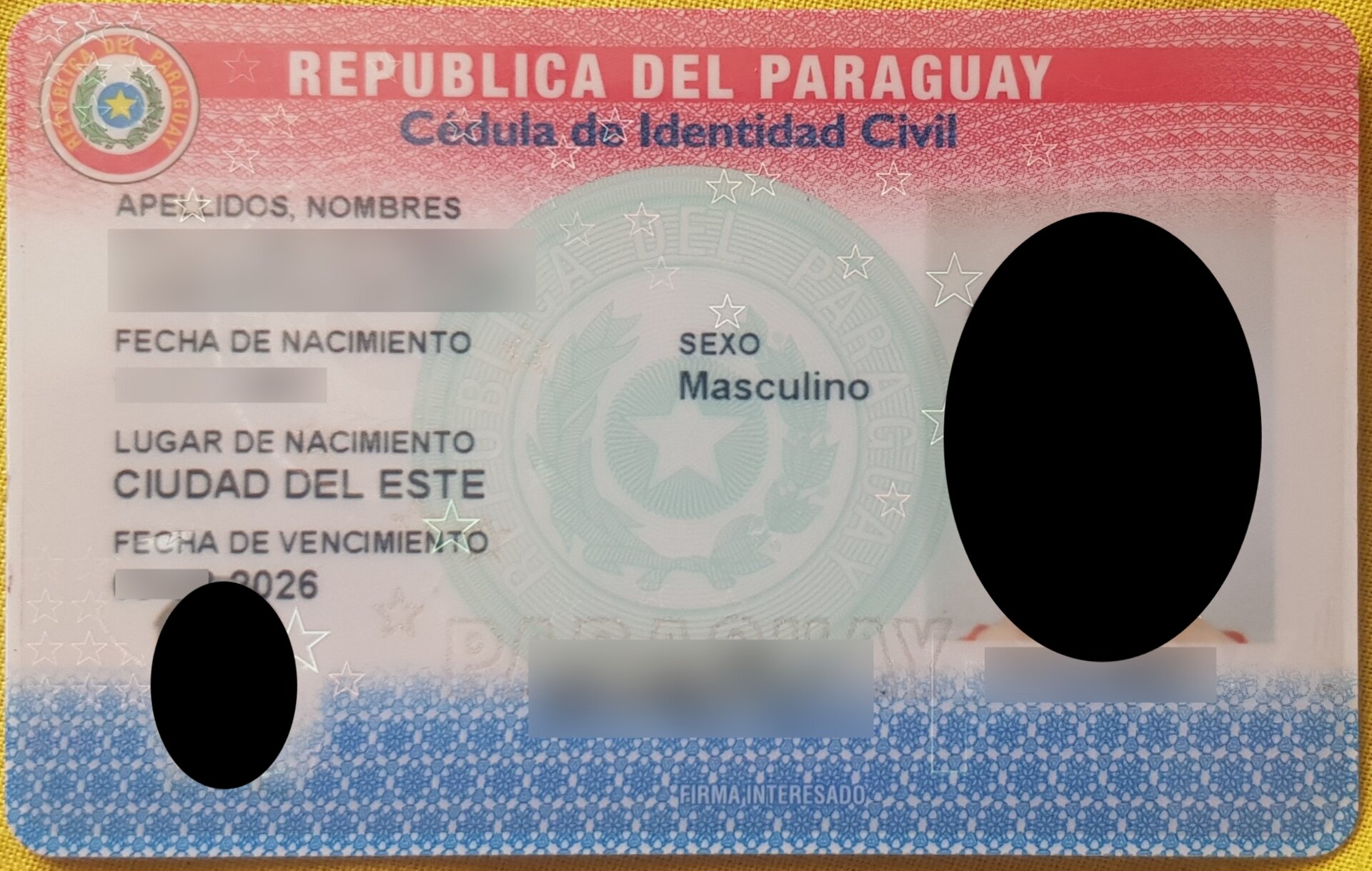 The Paraguayan cédula.
Paraguay residency itself is fast and affordable. The temporary residency process takes 2 to 4 months and costs roughly $1,200 to $1,400 if you handle it yourself, or $1,700 to $3,000 with professional help. You need your passport, apostilled birth certificate, apostilled FBI background check (for Americans) or equivalent, proof of a local address, and a Paraguayan medical certificate. After roughly two years of temporary residency, you’re eligible to upgrade to permanent residency.
What to Watch Out For
This strategy is legal, well-established, and used by thousands of expats and digital nomads. But there are a few things to get right.
Source-of-income rules matter. Paraguay’s territorial system hinges on where income originates, not where you receive it. If you’re providing services to Paraguayan clients or generating revenue from Paraguayan customers, that income is locally-sourced and taxed at 10%. The 0% rate applies only to genuinely foreign-sourced income.
Filing deadlines are real. Paraguay’s Marangatu filings are monthly. US tax returns and Form 5472 are annual. Missing either creates penalties. Build the filing dates into your calendar from day one.
Cutting home country ties must be thorough. For non-US passport holders, this is the most important (and most commonly botched) part of the strategy. If your home country’s tax authority determines you’re still a tax resident there, you’ll owe taxes in both places. Get professional advice specific to your country before making the move.
The FEIE has limits. For Americans, the FEIE covers earned income up to $132,900. If your LLC profits exceed that, the excess is subject to US federal income tax at your marginal rate. And self-employment tax applies to the full amount regardless.
US state taxes vary. Form your LLC in a state with no state income tax (Wyoming, Delaware, Nevada, etc.). If you form in a state that has income tax, you may owe state taxes even while living abroad.
Every Situation Is Different
The US LLC + Paraguay territorial tax strategy is powerful, but it’s not one-size-fits-all. Your nationality, your income sources, your business structure, your family situation, and your long-term goals all affect what the optimal setup looks like. What works perfectly for a single American freelancer billing US clients might need adjustments for a European couple running an e-commerce business. Tax optimization, revenue optimization, and compliance all need to work together.
We set up Paraguay residency and US LLCs for individuals. Whether you’re just starting to research, halfway through the process, or already here and need to get the structure right, reach out to us here and we’ll get it done, affordably.