
US LLC + Paraguay Territorial Tax: The Complete 2026 Strategy
A freelance developer in Asuncion earns $120,000 per year from US clients through a Wyoming LLC. His federal income tax is zero. His total US tax obligation is roughly $17,000 in self-employment tax. His work in Asuncion is Paraguayan-source income subject to local tax. The roughly 14% figure covers his US tax only, down from the 30% or more in US taxes he would pay living in the States.
A British marketing consultant earns $150,000 from clients across Europe. She properly severed her UK tax residency, moved to Paraguay, and runs her business through a Wyoming LLC. Her UK tax obligation is zero. Her US tax obligation is zero (she files one information return per year). Her work performed in Paraguay is subject to Paraguayan tax, even though her clients and LLC are abroad.
These are not hypothetical structures. This is how thousands of expats and digital nomads are operating right now. The US LLC plus Paraguay territorial tax combination is the most common international tax setup in the expat world for a reason: it works, it is legal, and the math is compelling.
But the details matter enormously. The source-of-income rules, the FBAR requirements, the self-employment tax that the FEIE does not cover, the compliance obligations that carry $25,000 penalties if you miss them. Most articles about this topic give you the headline and skip the parts that actually determine whether the strategy works for you.
This one does not skip those parts.
Originally published April 30, 2026. Updated October 10, 2026.
 Palacio de los López, Asuncion
How Paraguay’s Territorial Tax System Actually Works
Paraguay taxes only income that originates within its borders. Genuinely foreign-source income is outside Paraguayan personal income tax. Services performed in Paraguay are locally sourced, with personal-service IRP rates of 8% to 10% on taxable net income; a foreign client does not change that.
To access this system, you need to become a Paraguayan tax resident. That means obtaining your cedula (national ID card) through the residency process and then registering for your RUC (Registro Unico de Contribuyente), which is Paraguay’s taxpayer identification number.
Once your RUC is active, you file monthly tax returns through the Marangatu online system. Even if you owe nothing because all your income is foreign-sourced, you still file every single month. This is not optional. A missed Marangatu filing triggers fines, and consistent non-filing can jeopardize your tax status. Set calendar reminders, or have your Paraguayan accountant (contador) handle it. Most contadors charge $50 to $100 per month for this service.
The territorial system applies equally to temporary and permanent residents. You do not need to wait for permanent residency to benefit. Once your cedula and RUC are active, you are in the system.
The Source-of-Income Rule: What Most People Get Wrong
This is the single most important section in this article. Paraguay’s territorial system hinges entirely on where income is sourced. Get this wrong and the 0% rate does not apply.
The question is straightforward in theory: where does the income originate? In practice, it is the area where people make mistakes.
Clear cases. You are a web developer in Asuncion building software for a company in Austin, Texas. Your client is American, the users are American, and the economic value is consumed in the United States. That work is Paraguayan-sourced. The client’s location does not change where you performed the services.
You are a consultant advising a Paraguayan manufacturing company on their operations. Your client is in Paraguay, the value you create stays in Paraguay. That income is locally-sourced, subject to the personal-service IRP rates of 8% to 10%.
Work performed in Paraguay. Performing services from within Paraguay creates Paraguayan-source income even when the client is abroad. For work split between Paraguay and another country, the portion performed from Paraguay is locally sourced.
When your LLC invoices a US client and receives payment into a US bank account, the transaction chain documents your business, but it does not turn services performed in Paraguay into foreign-source income.
What actually triggers local sourcing. Work you perform in Paraguay is locally sourced. If you have a physical office in Paraguay where employees serve customers, that activity is locally sourced too. The currency on the invoice and the customer’s country do not decide the source.
The practical rule: keep records of where you do the work as well as your clients, invoices, and payments. A US LLC and a US bank account are useful business tools, but 100% foreign clients does not mean a 0% Paraguayan tax rate.
Why a US LLC and Not Something Else
 The US LLC ties you into the US banking system.
You need a business vehicle. The question is which one. Here is why the US LLC wins for most people in this situation.
US LLC vs. Paraguayan SRL (Sociedad de Responsabilidad Limitada). A Paraguayan SRL is the local equivalent of an LLC. It works fine for local business. A foreign LLC does not change the Paraguayan source of work you do in Paraguay. An SRL also does not give you access to US banking infrastructure, US business credit, or the universal client recognition that a US entity carries. And maintaining an SRL requires a Paraguayan accountant, annual filings with the local commercial registry, and compliance with Paraguayan corporate law. For someone serving international clients, the SRL adds cost and complexity without meaningful benefit.
US LLC vs. UK LLP or Singapore entity. Both are legitimate options, but they are more expensive to form and maintain, come with more complex filing requirements, and do not connect you to the US banking system. A UK LLP requires annual filings with Companies House and potentially a UK tax return. A Singapore entity requires a local director, annual audits in some cases, and corporate tax filings. A Wyoming LLC costs $100 to form, $60 per year in state fees, and connects you to Mercury, Relay, and the entire US banking ecosystem. For solo operators and small teams, the cost-benefit comparison is not close.
US LLC vs. no entity (operating as a sole proprietor). You can technically operate without an entity, but you lose three things: a separate business entity, access to US business banking and credit building, and the professional appearance that US clients expect when they pay an invoice. The LLC costs under $300 per year to maintain. That is worth it.
A Wyoming LLC is the standard recommendation: zero state income tax, strong privacy protections, and the lowest fees. Delaware is also popular (stronger case law and corporate governance framework) but slightly more expensive with an annual franchise tax.
The Setup for Americans
 Asuncion’s downtown.
Americans are taxed on worldwide income regardless of where they live. The US is one of two countries in the world that does this (the other is Eritrea). Moving to Paraguay does not change your US tax obligations. But it changes the math significantly.
The Foreign Earned Income Exclusion (FEIE)
The FEIE lets qualifying US citizens or residents exclude up to $132,900 (2026 amount) of foreign earned income from federal income tax. If both spouses work abroad, the combined exclusion is $265,800. You qualify by passing either the Physical Presence Test (330 full days outside the US in a rolling 12-month period) or the Bona Fide Residence Test (genuine resident of a foreign country for a full calendar year). For someone with Paraguay residency, a cedula, a RUC, and a local address, the Bona Fide Residence Test is the natural path.
The Foreign Housing Exclusion
Most articles about this strategy skip this entirely. On top of the FEIE, qualifying Americans can also claim the Foreign Housing Exclusion, which lets you exclude certain housing expenses (rent, utilities, insurance, parking) that exceed a base amount set by the IRS (roughly $19,000 in 2026, though it varies by location). If your annual rent in Asuncion is $7,200 ($600 per month) and your total qualifying housing expenses are $10,000, the excess above the base threshold may not help much in Paraguay because rent is so low. But for higher-rent situations (a family renting a large house) or for people who spent part of the year in a more expensive city, this exclusion provides additional savings.
Self-Employment Tax: What the FEIE Does Not Cover
The FEIE eliminates federal income tax. It does not touch self-employment tax. If you are the sole owner of a single-member LLC, you owe SE tax on your net self-employment income. The rates: 12.4% for Social Security on earnings up to $184,500 (2026 cap), plus 2.9% for Medicare on all earnings with no cap, plus an additional 0.9% Medicare surtax on earnings above $200,000 for single filers.
Paraguay does not have a social security totalization agreement with the United States. There is no treaty mechanism to reduce or offset this.
US Tax Math: Three Scenarios
Scenario 1: Freelance developer, $100,000 per year.
SE tax base: $100,000 x 92.35% = $92,350. Social Security: $92,350 x 12.4% = $11,451. Medicare: $92,350 x 2.9% = $2,678. Total SE tax: $14,129. Federal income tax (FEIE covers all $100K): $0. Paraguayan tax on work performed there is additional. US tax subtotal: $14,129. US effective rate: 14.1%.
Living in the US (single, Texas, no state income tax): federal income tax roughly $14,500 plus SE tax $14,129 = $28,629. US effective rate: 28.6%. US tax reduction: roughly $14,500, before Paraguayan taxes.
Scenario 2: Consultant, $180,000 per year.
SE tax base: $180,000 x 92.35% = $166,230. Social Security: $166,230 x 12.4% = $20,613. Medicare: $166,230 x 2.9% = $4,821. Total SE tax: $25,434. Federal income tax: FEIE covers $132,900. Remaining $47,100 taxed at marginal federal rates, roughly $7,700 (22% bracket for a single filer after standard deduction). Paraguayan tax on work performed there is additional. US tax subtotal: $33,134. US effective rate: 18.4%.
Living in the US: federal income tax roughly $31,000 plus SE tax $25,434 = $56,434. US effective rate: 31.4%. US tax reduction: roughly $23,300, before Paraguayan taxes.
Scenario 3: High earner, $250,000 per year.
SE tax base: $250,000 x 92.35% = $230,875. Social Security: $184,500 (cap) x 12.4% = $22,878. Medicare: $230,875 x 2.9% = $6,695. Additional Medicare (above $200K): roughly $280. Total SE tax: roughly $29,853. Federal income tax: FEIE covers $132,900. Remaining $117,100 is taxed at the marginal rates that would have applied without the exclusion (the IRS stacking rule), which puts most of it in the 24% and 32% brackets. After standard deduction, roughly $28,000. Paraguayan tax on work performed there is additional. US tax subtotal: roughly $57,850. US effective rate: roughly 23%.
Living in the US: federal income tax roughly $53,000 plus SE tax $29,853 = roughly $83,000. US effective rate: 33%. US tax reduction: roughly $25,000, before Paraguayan taxes. Add a state like California or New York and the savings jump by another $15,000 to $25,000 in avoided state income tax.
The pattern is clear. The FEIE eliminates federal income tax on the first $132,900. Above that, you pay federal income tax on the excess. Self-employment tax applies to the full amount regardless. But the total is still dramatically less than operating from the US, and any state income tax you were paying disappears entirely.
FBAR: The Filing Requirement Nobody Mentions
If you have a Paraguayan bank account (and you should, for daily expenses), and the aggregate balance of all your foreign financial accounts exceeds $10,000 at any point during the year, you must file an FBAR (Foreign Bank Account Report) with FinCEN by April 15. This is separate from your tax return. It is filed electronically through the BSA E-Filing system.
This is an information report, not a tax. But the penalty for willful failure to file is $100,000 or 50% of the account balance, whichever is greater. For non-willful failure, penalties can reach $10,000 per violation. Do not skip this. Your CPA should handle it alongside your annual return.
Your US bank accounts do not count as “foreign” for FBAR purposes. Only your Paraguayan accounts (and any other non-US accounts) count toward the $10,000 threshold.
Annual US Compliance Checklist for Americans
Federal income tax return (Form 1040 with Form 2555 for FEIE). Self-employment tax (Schedule SE). FBAR (FinCEN 114, due April 15). FATCA Form 8938 if your foreign financial assets exceed $200,000 at year-end or $300,000 at any point during the year (higher thresholds for married filing jointly). Monthly Marangatu filings in Paraguay (or have your contador handle these).
A US-based CPA experienced with expat returns typically charges $500 to $1,500 for the annual filing. A Paraguayan contador runs $50 to $100 per month.
The Setup for Non-Americans
This is where the strategy reaches its full power.
If you hold a passport from the UK, Canada, Australia, Germany, or most other countries with worldwide taxation, the first step is severing tax residency in your home country. This is critical, country-specific, and the part most people underestimate. Each country has different rules: the UK uses the Statutory Residence Test (tracking days in the country plus ties), Canada looks at significant residential ties (home, spouse, dependents), Australia considers domicile and permanent place of abode. Get professional advice from a tax advisor who specializes in your home country’s expatriation rules before you move.
Once you have properly severed home-country tax residency and established tax residency in Paraguay, the math is simple. Paraguay taxes foreign-sourced income at 0%. Your US LLC has no US tax liability because it is a single-member LLC owned by a non-resident alien with no US-source income.
Paraguayan tax is 0% on genuinely foreign-source income. Services you perform from Paraguay are subject to local tax.
Form 5472: The One Filing You Cannot Miss
The IRS requires non-US persons who own a US single-member LLC to file Form 5472 along with a pro forma Form 1120 each year. This is an information return, not a tax return. You are reporting the existence of the LLC and its transactions with its foreign owner (you). The LLC itself owes no federal tax.
The penalty for failing to file Form 5472 is $25,000 per form. This is not proportional to your income. It is a flat $25,000 regardless of whether your LLC earned $10,000 or $500,000. A CPA or filing service handles this for $300 to $800 per year. Pay it. The cost of non-compliance is catastrophic relative to the cost of compliance.
Country-Specific Considerations
UK. The Statutory Residence Test is complex but well-defined. Generally, spending fewer than 16 days per year in the UK (if you were resident in all three prior tax years) or fewer than 46 days (if you were not) keeps you non-resident. You should also sever significant UK ties: close UK bank accounts you do not need, avoid maintaining a UK home available for your use, and be prepared to document your departure if HMRC inquires.
Canada. The CRA looks at residential ties, particularly whether you have a home, a spouse, or dependents in Canada. Simply leaving is not enough. You should file a departure return, close or convert your TFSA and RRSP accounts as appropriate, and establish that your primary ties are now in Paraguay.
Australia. The ATO uses a domicile test plus a resides test. Australians who permanently emigrate generally need to demonstrate that their domicile has shifted. Keep records of your departure, your Paraguay residency, and your intention not to return.
In all cases, the order matters. Establish Paraguay residency first, sever home-country tax residency second, and begin operating through your US LLC third. If you start earning through the LLC before your home-country departure is clean, you risk being taxed in both places during the overlap.
How Crypto Income Fits
Paraguay’s territorial tax system treats crypto gains the same as any other income: genuinely foreign-source gains are outside Paraguayan income tax. Holding assets on a foreign exchange does not by itself establish the source.
However, as of March 2026, Paraguay issued Resolution 47/2026, which requires resident individuals and entities with more than $5,000 in annual crypto transactions to report detailed wallet-level data to DNIT. Wallet addresses, transaction hashes, blockchain networks, counterparty information, amounts, and USD values. This is a reporting requirement, not a tax. Your foreign-source crypto gains are still 0%, but the transaction data is now on file with the Paraguayan government.
Paraguay has committed to its first CRS exchanges in 2027. It is not on the OECD’s September 2026 CARF commitment list. CRS concerns financial accounts; CARF is the separate crypto-asset exchange framework. Domestic crypto reporting under Resolution 47 is a separate obligation.
For Americans, your crypto reporting obligations to the IRS are the same whether you live in Paraguay or Topeka. Report your gains, pay tax on anything not covered by the FEIE (crypto trading gains are typically capital gains, not earned income, so the FEIE does not apply to them). Long-term capital gains rates (0%, 15%, or 20% depending on income level) still apply.
For non-Americans who have properly severed home-country tax residency, genuinely foreign-source crypto gains are taxed at 0%; resident individuals and entities still report under Resolution 47 when annual transaction volume exceeds $5,000.
If crypto privacy is a top priority, Bolivia’s crypto banking and reporting rules differ alongside its own territorial tax system, though with different residency trade-offs.
What It Costs to Run This Structure
Here is the annual overhead for maintaining the full US LLC plus Paraguay tax residency setup, broken down by component.
Wyoming LLC annual fees. State annual report: $60. Registered agent: $100 to $200. Total: $160 to $260 per year.
US business banking. Mercury and Relay both offer free business checking with no monthly fees. Cost: $0.
Paraguay tax compliance. Monthly Marangatu filings through a local contador: $50 to $100 per month, or $600 to $1,200 per year.
US tax compliance (Americans). Annual federal return with FEIE, FBAR, and FATCA filings through an expat CPA: $500 to $1,500 per year.
US tax compliance (non-Americans). Annual Form 5472 and pro forma 1120 through a CPA or filing service: $300 to $800 per year.
Paraguay residency maintenance. Once you have your cedula, there are no annual fees to maintain residency status. Permanent residency requires a trip to Paraguay at least once every few years but has no recurring financial cost.
Total annual cost to run the structure:
Americans: roughly $1,260 to $2,960 per year. Non-Americans: roughly $1,060 to $2,260 per year.
Compare that to the $14,000 to $26,000 or more in annual tax savings from the scenarios above. The structure pays for itself many times over.
Running the US LLC + Paraguay setup and want to make sure you are getting the tax math right? We handle both the Paraguay residency and the US LLC formation, start to finish, and we make sure the structure fits your specific situation. Reach out to us here.
What Can Go Wrong
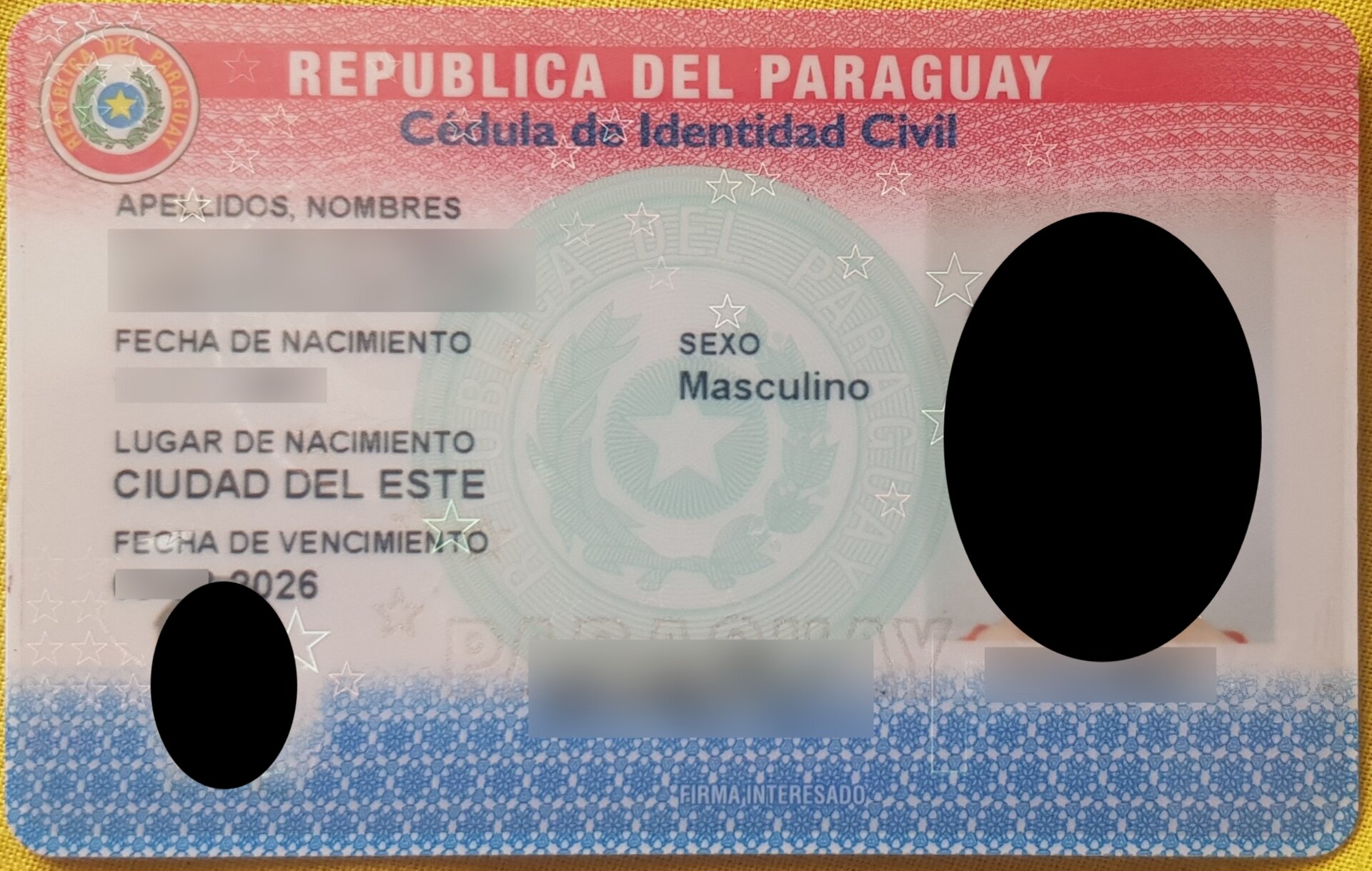 The Paraguayan cedula.
You take on Paraguayan clients without reporting. Any income from Paraguayan clients is locally-sourced and taxed at 10%. If you do not report it, you are evading taxes, not optimizing them. Keep your client base international, or report the local portion properly.
You miss Marangatu filings. Monthly filings are mandatory even when you owe nothing. Missed filings trigger fines and can create problems when you apply for permanent residency or need tax clearance certificates.
You miss Form 5472 (non-Americans). The $25,000 penalty is not negotiable and the IRS does enforce it. File every year.
You skip the FBAR (Americans). Similar story. The penalties are severe and FinCEN has been increasing enforcement on foreign account reporting.
You do not properly sever home-country tax residency (non-Americans). This is the most expensive mistake. If your home country still considers you a tax resident, you owe taxes there on your worldwide income. Paraguay’s 0% rate does not help if you are also paying 40% to HMRC or the CRA. Get professional advice before you move, not after.
Your income exceeds the FEIE cap and you do not plan for it. If your LLC profits are growing past $132,900, work with your CPA to model the tax impact. There may be structural options (S-Corp election, hiring yourself as an employee of the LLC to split income between salary and distributions, contributing to a solo 401k to reduce taxable income) that reduce the federal tax on the excess. These structures add complexity but can be worth exploring at higher income levels.
Paraguay Residency: How to Start
The residency process itself takes 60 to 100 days from application to cedula in hand. Total cost is roughly $3,000 to $5,000 all-in with a lawyer. You need your passport, an apostilled birth certificate, a local medical exam, an Interpol background check (done in Paraguay), and proof of financial solvency.
After two years of temporary residency, you apply for permanent residency. After three years of permanent residence, you can apply for naturalization, usually about five years from the initial temporary permit. Dual nationality is subject to Paraguay’s constitutional and treaty rules.
The country itself is among the most affordable in South America. Asuncion is a calm, safe city with a growing expat community. The cost of living is roughly $1,000 to $1,500 per month for a single person living well. Safety is solid, with a Level 1 US State Department travel advisory, the same rating as France and the UK.
Every Situation Is Different
The US LLC plus Paraguay territorial tax strategy is powerful, but it is not one-size-fits-all. Your nationality, your income level, your client base, your crypto holdings, your family situation, and your long-term plans all affect what the optimal setup looks like. What works for a solo American freelancer earning $100,000 is different from what works for a European couple running a $500,000 e-commerce business.
We set up Paraguay residency and US LLCs for individuals and families. Whether you are researching, mid-process, or already here and need to get the structure right, we will get it done. Reach out to us here to get started.